
Free lesson: Borrowing Wisely (Grade 10 Career Studies)
Try a complete lesson free: students compare six forms of borrowing, learn how credit scores work and see how much a smaller monthly payment on a credit card really costs.
6 free lessons
Try a complete lesson free: students compare six forms of borrowing, learn how credit scores work and see how much a smaller monthly payment on a credit card really costs.
Try a complete lesson free: students learn the difference between open influence and foreign interference, study the methods and the defences, and check a fake voting post step by step.
Try a complete lesson free: students head outside to measure something too tall to reach, using similar triangles with shadows and a mirror, then compare their two results and explain the error.
Try a complete lesson free: students react baking soda and vinegar in an open cup and a sealed bag, measure the mass before and after, and explain the law of conservation of mass.
Try a complete lesson free: students investigate the 1918 influenza in an invented Ontario town using a diary, a public notice, a photograph and a data table, then write a conclusion supported by evidence.
Try a complete lesson free: students learn plot structure as a heist map, then predict and listen their way through Part I of “The Monkey's Paw.”
9 items
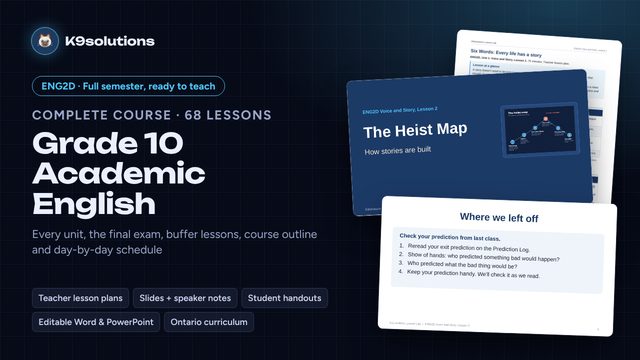
Everything you need to teach Grade 10 Academic English for a full semester: six units, an independent novel study, the culminating task, a final exam and five buffer lessons.
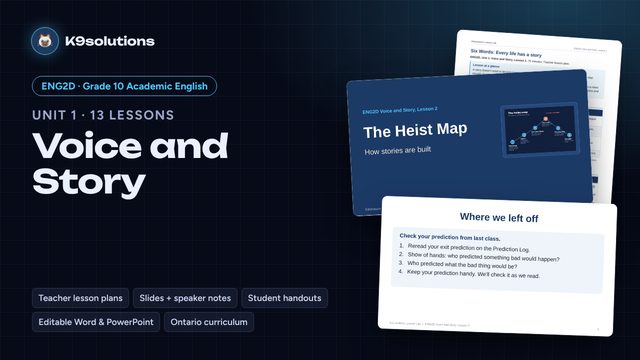
Short stories and personal narrative: four classic stories, a heist-map approach to plot and a personal narrative in each student's own voice.
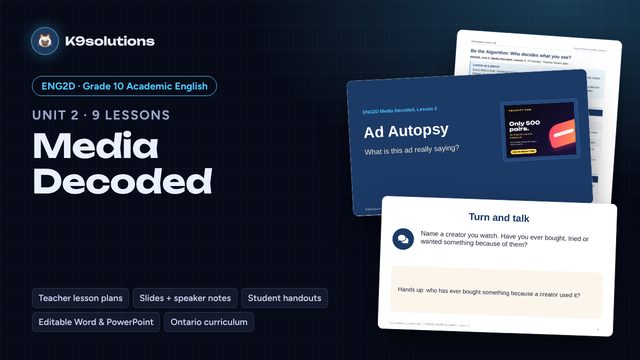
Algorithms, ads, influencers, AI fakes, news framing and thumbnails, ending with a public service campaign students design themselves.
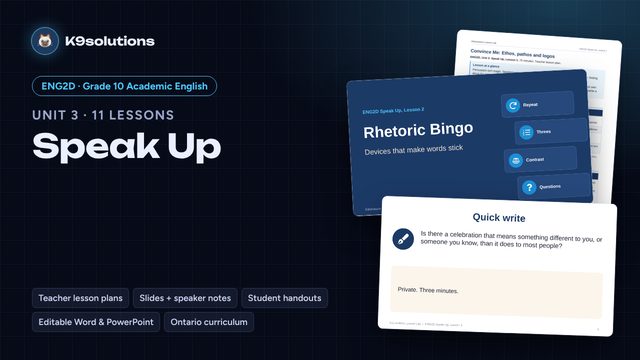
Rhetoric, argument and persuasive speech, from Lincoln and Sojourner Truth to a Shark Tank pitch and a three-minute talk.
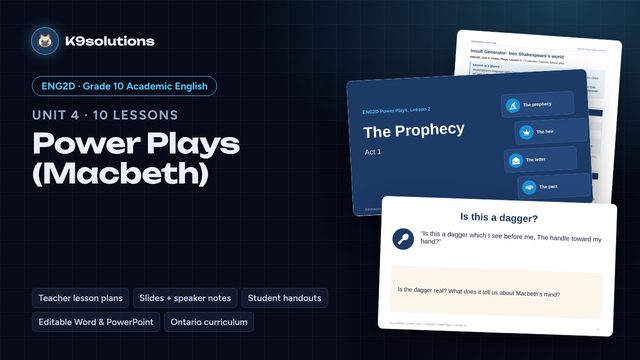
Shakespeare's Macbeth through performance, investigation and debate: insults, a crime board, a group chat rewrite and a mock trial.
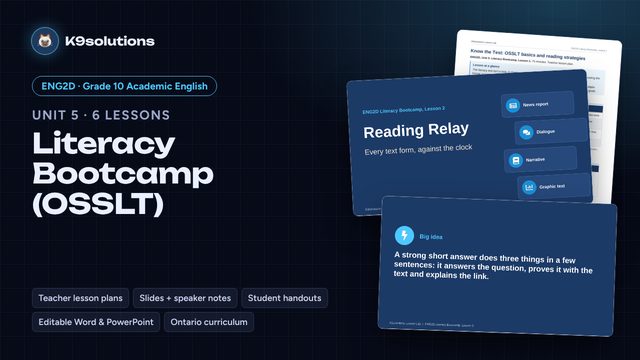
Upbeat OSSLT preparation with original practice passages, a reading relay, an error-hunt escape room and the official online practice test.
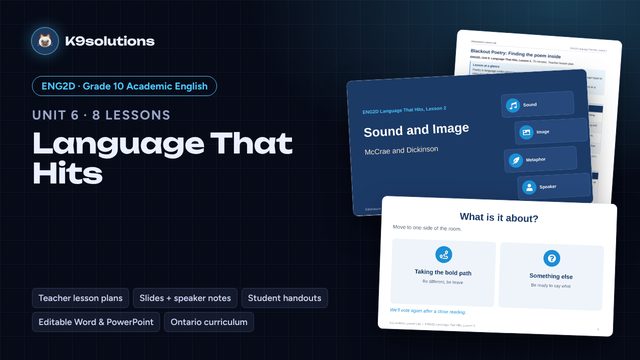
Poetry, lyrics and spoken word: blackout poems, classic poems, song lyric breakdowns and a class slam.
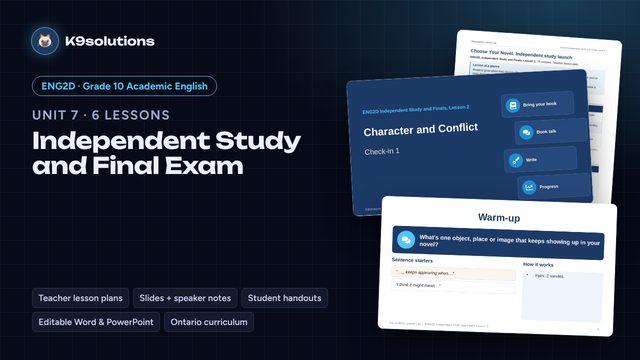
An independent novel study with check-ins, a student-led seminar and portfolio, and a final exam with an original sight passage.
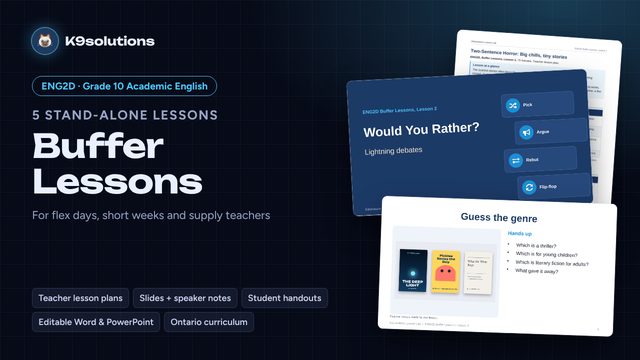
Five no-prep, stand-alone English lessons for flex days, short weeks and supply teachers.
10 items
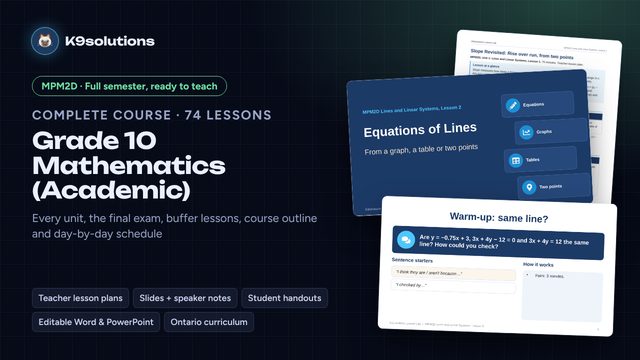
Everything you need to teach Grade 10 academic math for a full semester: seven units covering linear systems, analytic geometry, quadratic relations, expressions and equations, and trigonometry, plus a culminating design task and a final exam.
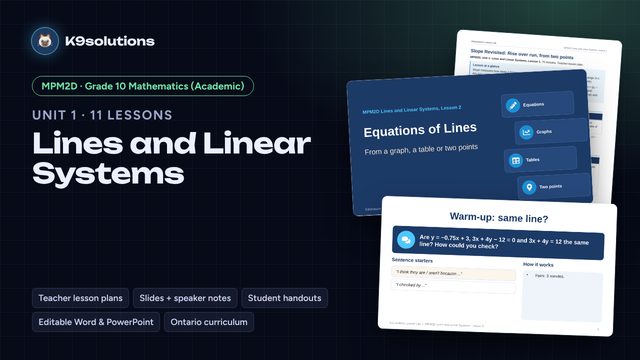
Slope as a rate of change, equations of lines in every form, parallel and perpendicular lines, and solving linear systems by graphing, substitution and elimination, with real problems and an optional coding lesson.
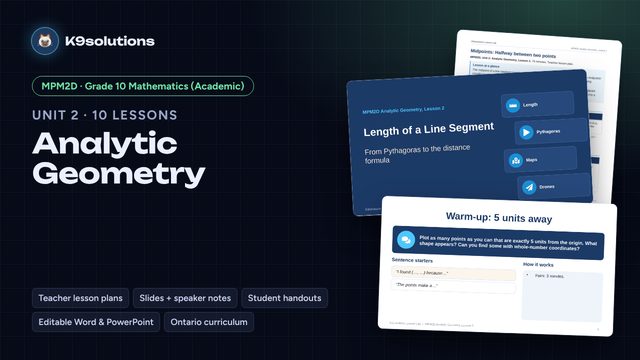
The midpoint and length formulas, circles centred at the origin, right bisectors, medians and the shortest distance to a line, and multi-step verifications of triangle and quadrilateral properties.
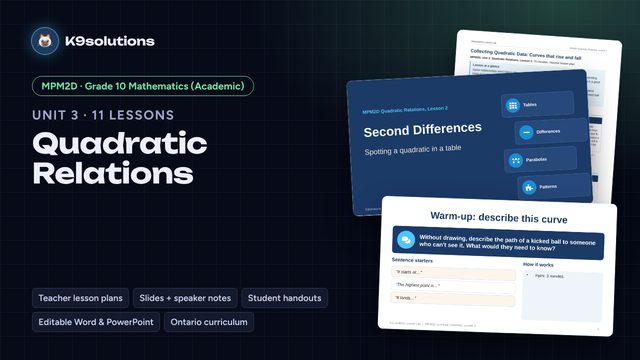
Collecting quadratic data, second differences, key features of parabolas, zero and negative exponents, transformations and vertex form, sketching with the step pattern, and writing equations from graphs.
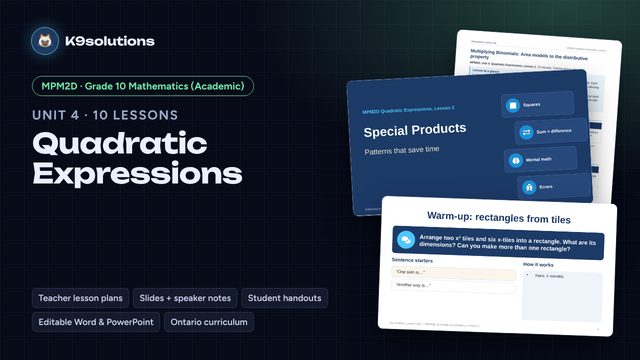
Expanding with area models and algebra tiles, special products, common factoring and grouping, factoring trinomials (including decomposition), and connecting factored form to zeros, the axis and the vertex.
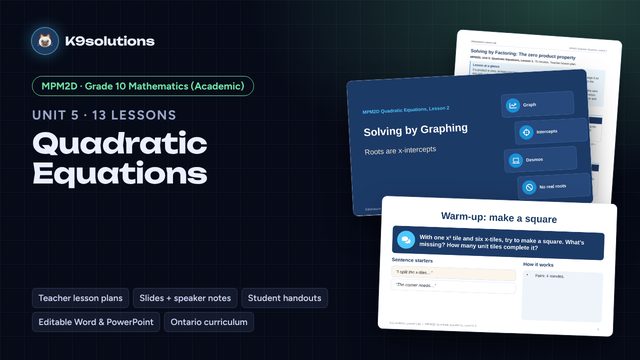
Solving by factoring and graphing, completing the square, vertex form, the story and use of the quadratic formula, the discriminant, and maximum, projectile, area and revenue problems.
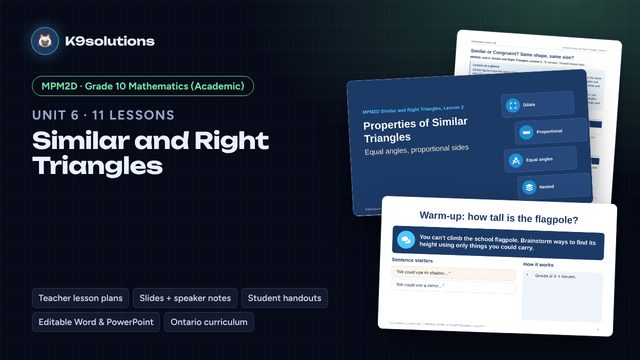
Similar and congruent figures, properties of similar triangles, an outdoor indirect measurement lab, the primary trigonometric ratios, finding sides and angles, a homemade clinometer, and trigonometry at work.
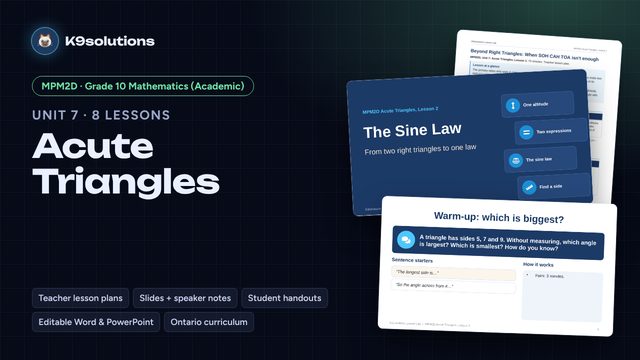
Why the primary ratios need a right angle, following the development of the sine law and the cosine law, using both laws, choosing the right tool, and solving navigation, surveying, roofing and sports problems.
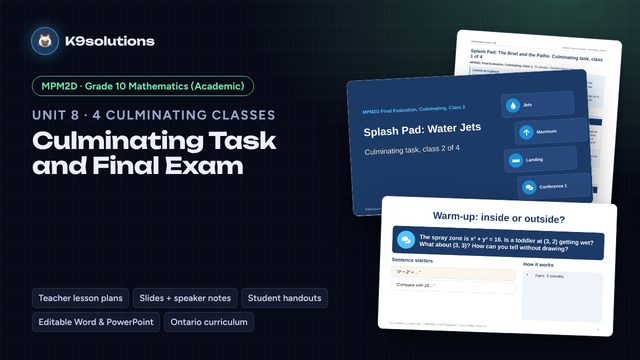
Design the Splash Pad, a four-class culminating design task that uses every strand of the course, two review classes, and a two-hour final exam with a make-up version and a full marking guide.
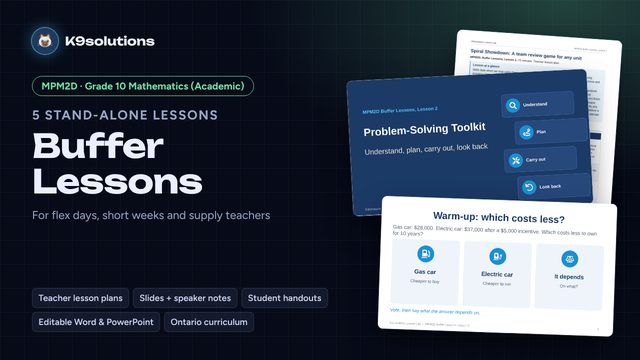
Five stand-alone MPM2D lessons for flex days, short weeks and supply teachers, each tied to specific curriculum expectations.
8 items
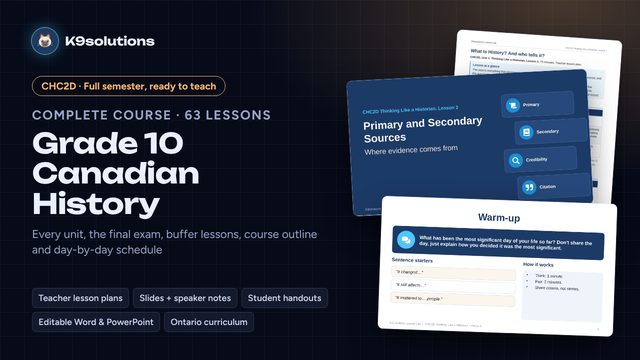
Everything you need to teach Grade 10 Canadian History since World War I for a full semester: six units from historical thinking to Canada today, original source sets, every summative with a rubric, the culminating inquiry and a final evaluation.
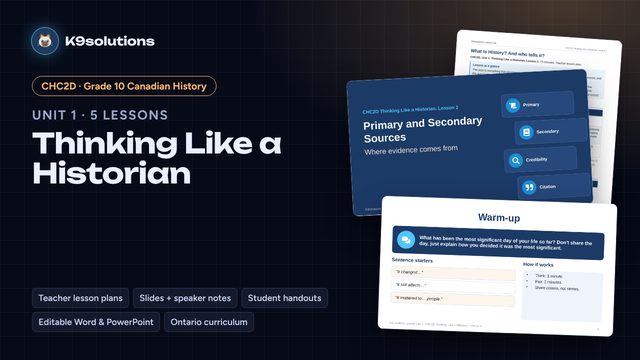
Historical inquiry from the ground up: question types, primary and secondary sources, the four concepts of historical thinking and an original 1918 source set, ending with a document-based Source Detective task.
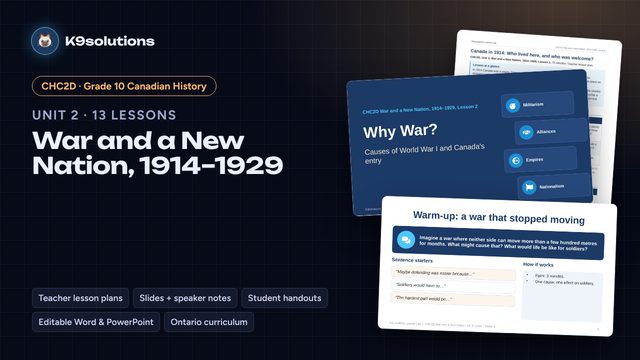
World War I, the home front, conscription, the Winnipeg General Strike, residential schools, the vote for women and the Roaring Twenties, ending with a Turning Point museum exhibit.
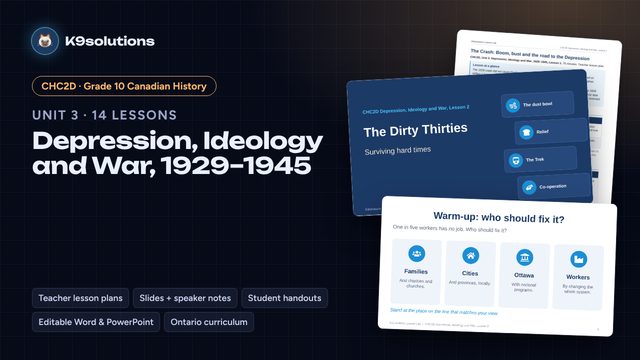
The Depression, extreme ideologies and the Holodomor, antisemitism in Canada, World War II at home and overseas, internment and the Holocaust, ending with a Voices of the Era perspective project.
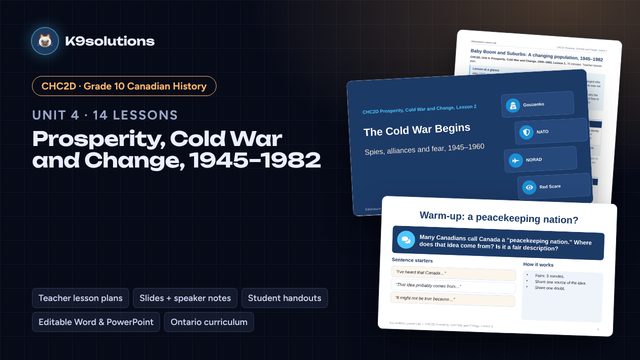
The Cold War, the welfare state, Black Canadians' fight for equality, Indigenous rights, the Quiet Revolution, women's rights and the Charter, ending with a Defining Moments debate.
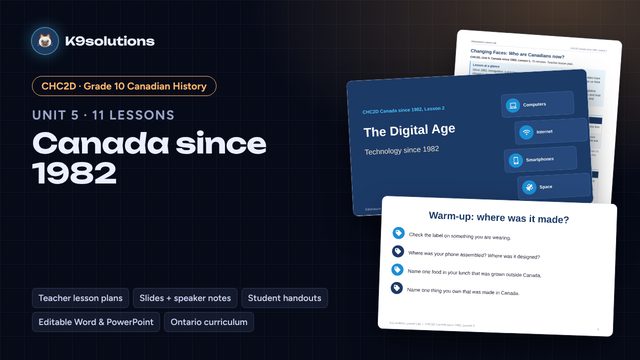
Free trade, Quebec and the Constitution, regionalism, land rights and reconciliation, rights and citizenship and Canada in the world, ending with an Unfinished Business policy brief.
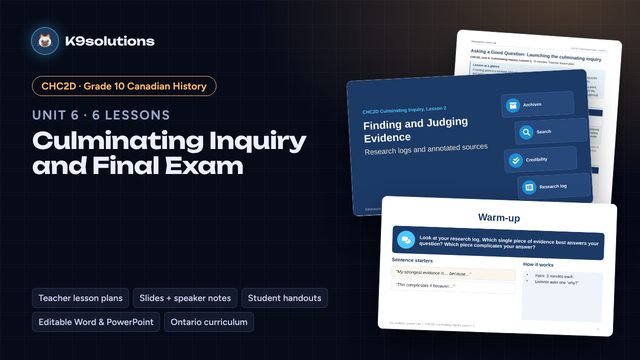
A culminating historical inquiry into a turning point since 1914, review lessons across the century, and an original written final exam with a marking guide.
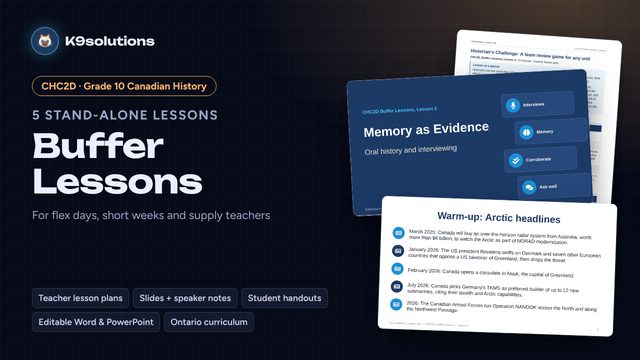
Five stand-alone CHC2D lessons for flex days, short weeks and supply teachers, each tied to specific curriculum expectations.
8 items
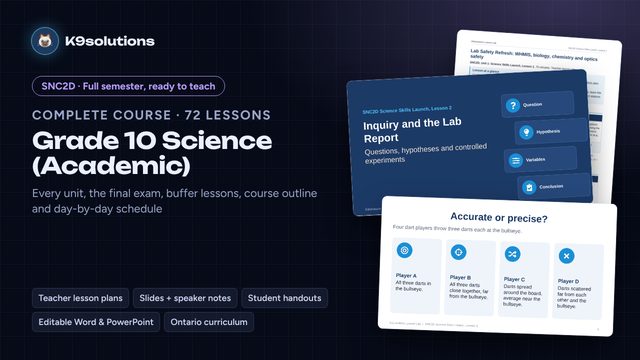
Everything you need to teach Grade 10 Academic Science for a full semester: a skills launch, biology, chemistry, climate change and optics units, an independent investigation and a final exam.
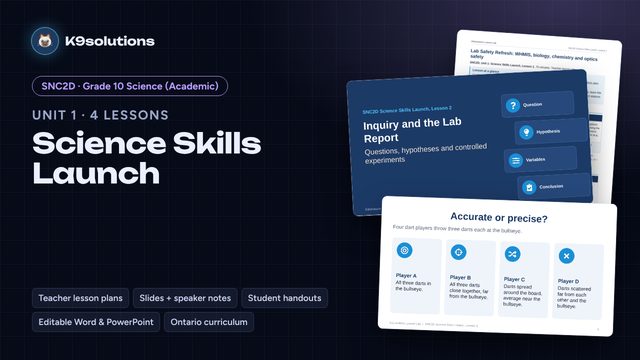
A short launch unit for the skills students use all year: lab safety, controlled inquiry and the lab report, significant digits and percent error, reliable sources and APA citations, and Canadian scientists and careers.
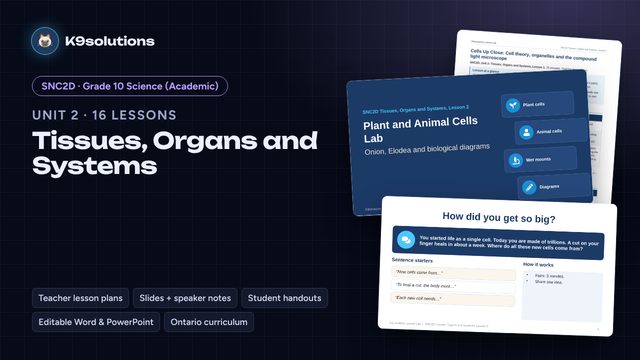
Cells under the microscope, the cell cycle and mitosis, cancer, specialized cells and stem cells, plant and animal tissues, organs and systems, a dissection, disease, medical imaging, public health and ethics.
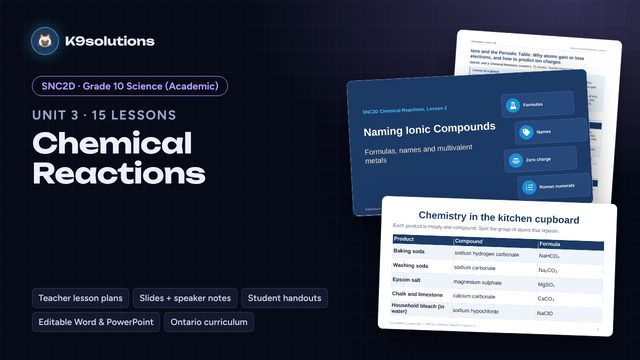
Ions, naming and formulas for ionic and molecular compounds, evidence of chemical change, conservation of mass, balancing equations, the main reaction types, acids, bases and neutralization, and reactions in safety and the environment.
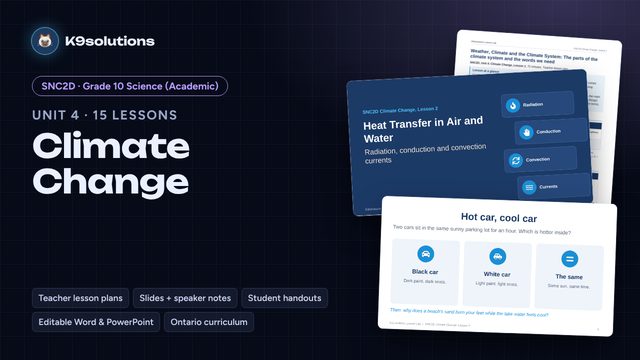
The climate system, heat transfer, albedo, ocean currents, the greenhouse effect, greenhouse gases, ozone and smog, proxy data, natural and human causes, climate regions, global effects, media literacy and climate initiatives.
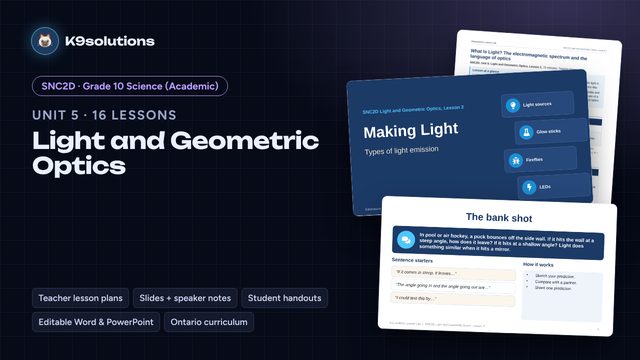
The electromagnetic spectrum, sources of light, reflection, plane and curved mirrors, ray diagrams, the mirror and thin lens equations, refraction and the index of refraction, total internal reflection, lenses, the eye and light technologies.
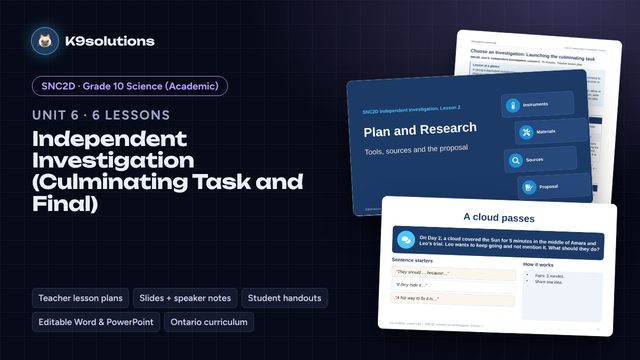
The end of the course: an independent inquiry or research investigation with a proposal, safety plan, analysis and presentation, plus a course review and an original final written exam with an answer key.
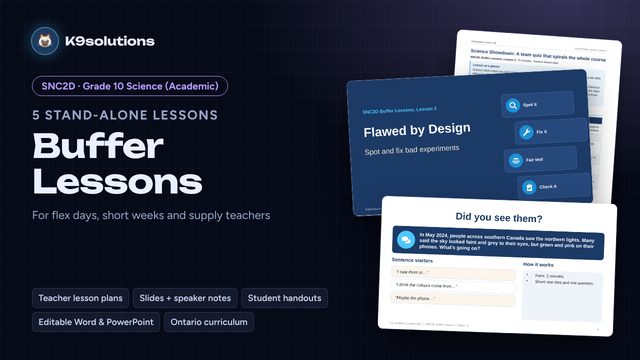
Five stand-alone SNC2D lessons for flex days, short weeks and supply teachers, each tied to specific curriculum expectations.
8 items
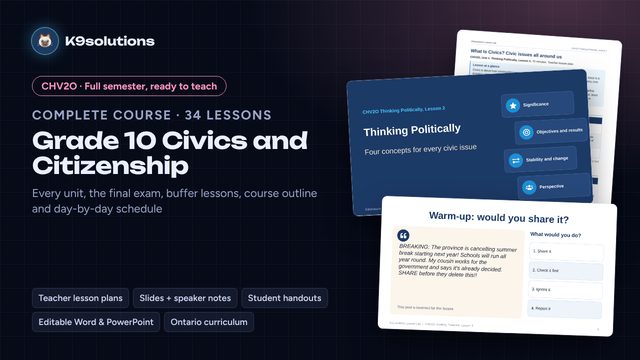
Everything you need to teach Grade 10 Civics and Citizenship: six units from political thinking to a culminating Civic Action Plan, Indigenous governance and treaties, foreign interference, original scenarios and data, every summative with a rubric, and a written final exam.
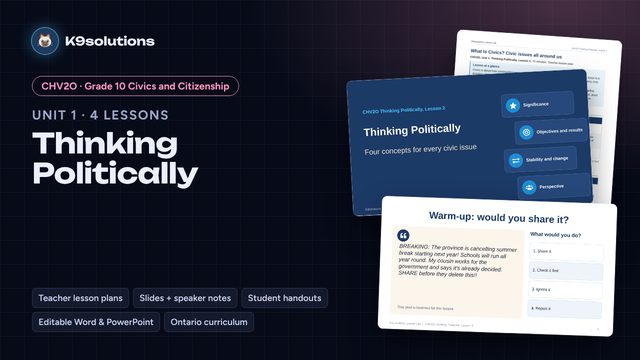
Civic issues, the political inquiry process, the four concepts of political thinking, checking sources and social media, and respectful discussion, ending with a Civic Issue Snapshot.
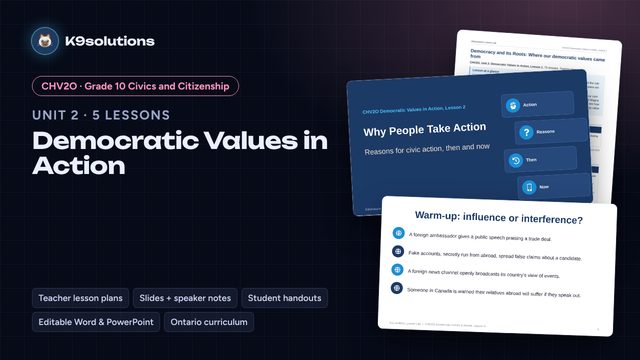
Democratic values and their roots, why people take civic action, foreign interference and disinformation, parties and the political compass, and taking a position, ending with a Values in Action case study.
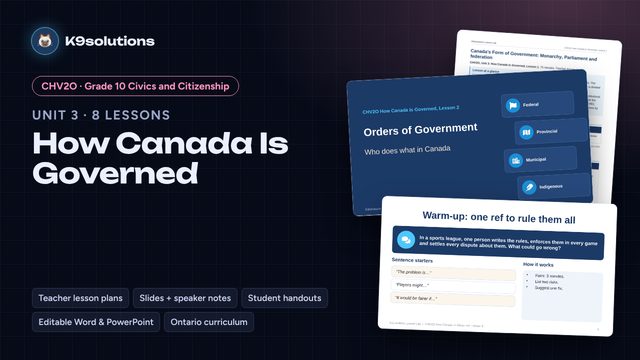
Canada's form of government, orders and branches of government, Indigenous governance and treaties, law-making, taxes and budgets, elections and who influences policy, ending with a Government in Action Brief.
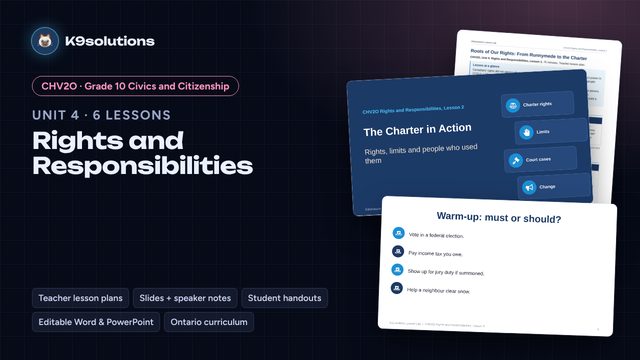
The roots of our rights, the Charter in action, responsibilities of citizenship, courts and the public good, and human rights around the world, ending with a Rights Case File.
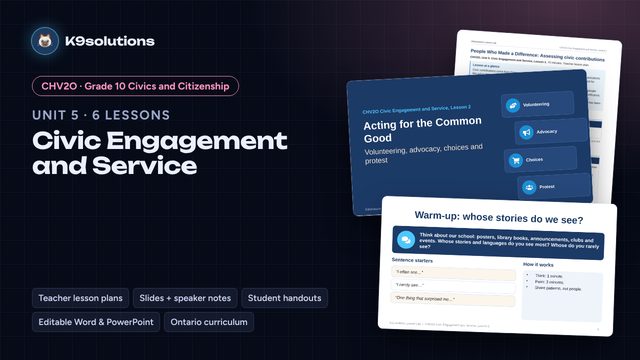
Civic contributions, acting for the common good, whose voices count, pride and commemoration, making your voice heard and youth service, ending with a Service and Recognition Project.
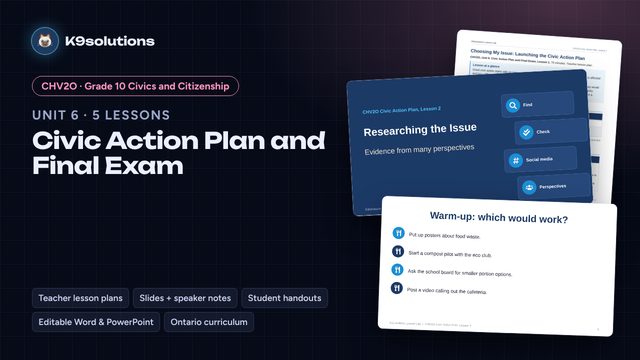
The culminating Civic Action Plan, from choosing an issue to presenting a plan, plus course review and an original written final exam with a marking guide.
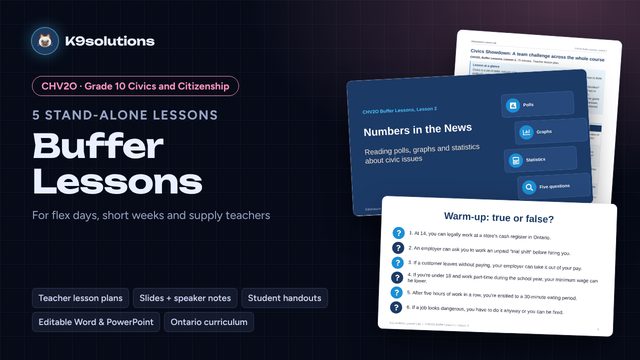
Five stand-alone CHV2O lessons for flex days, short weeks and supply teachers, each tied to specific curriculum expectations.
8 items
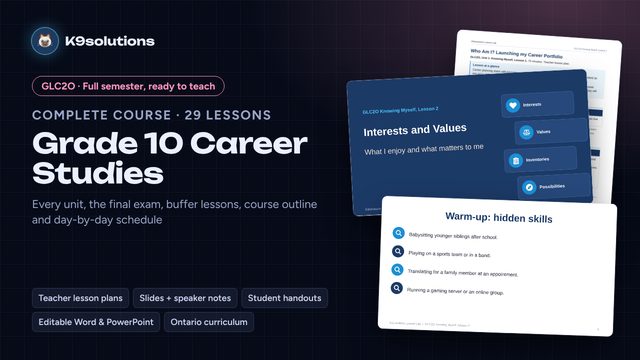
Everything you need to teach Grade 10 Career Studies: six units from a personal profile and well-being to pathways, workers' rights, money and a first-year plan, with a Career Portfolio that runs all course, every summative with a rubric, and the culminating task.
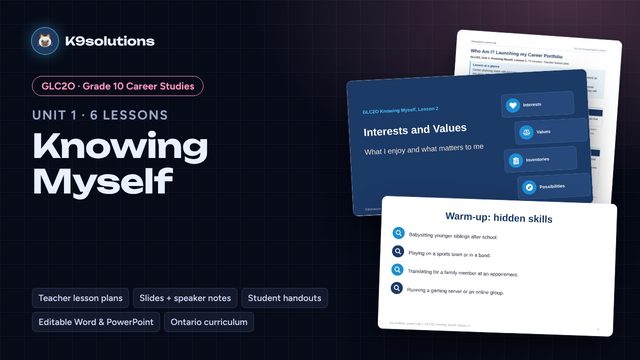
Launching the Career Portfolio: interests, values, skills and strengths, resilience, managing stress and balance, and getting support, ending with My Personal Profile.
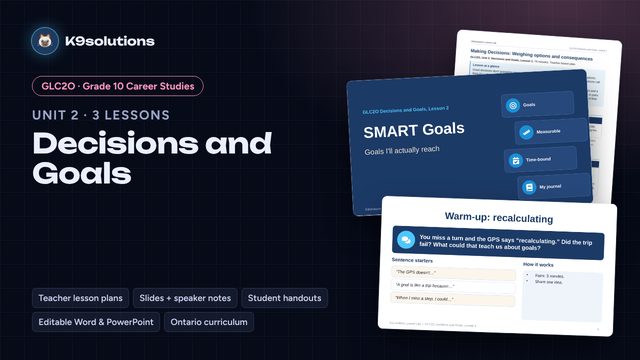
Decision-making strategies, SMART goals, and tracking and revising goals, ending with a Goal-Setting Journal.
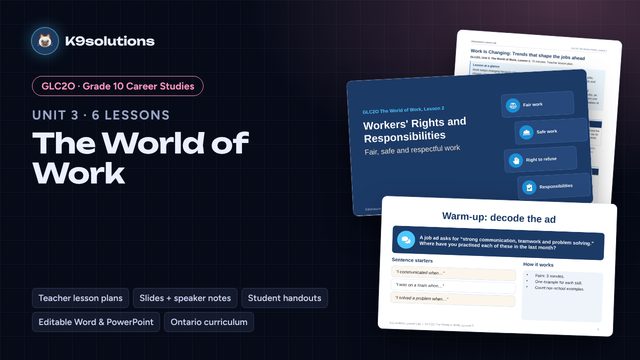
How work is changing, workers' rights and responsibilities, transferable skills, influences on our choices, digital footprints and networking, ending with a Future of Work Report.
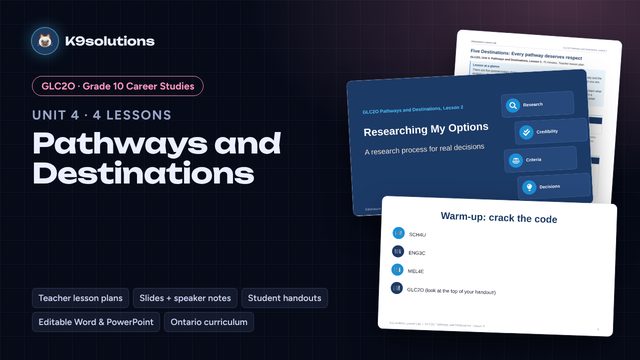
The five postsecondary destinations, researching options, secondary school pathways and diploma requirements, and programs and supports, ending with a Destination Comparison.
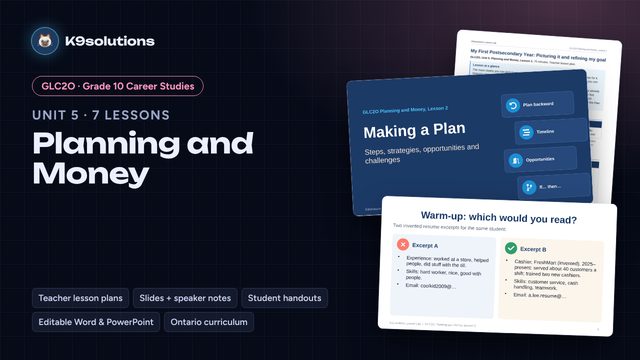
A first postsecondary year, a plan, resumes, cover letters, interviews, saving, borrowing and a first-year budget, ending with an Application Package and Budget.
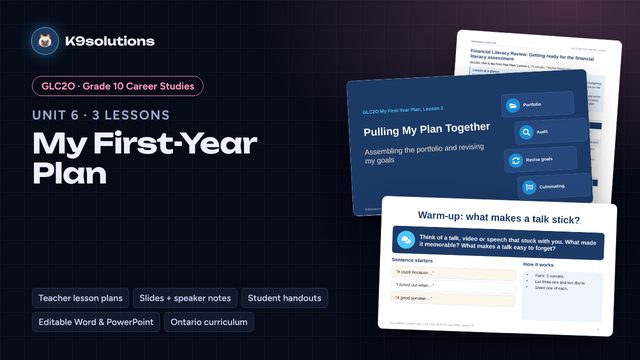
A financial literacy review, then pulling the Career Portfolio together into the culminating My First-Year Plan presentation.
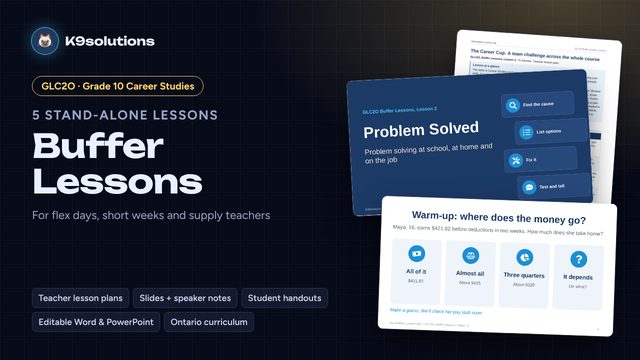
Five stand-alone GLC2O lessons for flex days, short weeks and supply teachers, each tied to specific curriculum expectations.
No lesson plans match that. Try another word.