
CHV2O Unit 4: Rights and Responsibilities
The roots of our rights, the Charter in action, responsibilities of citizenship, courts and the public good, and human rights around the world, ending with a Rights Case File.
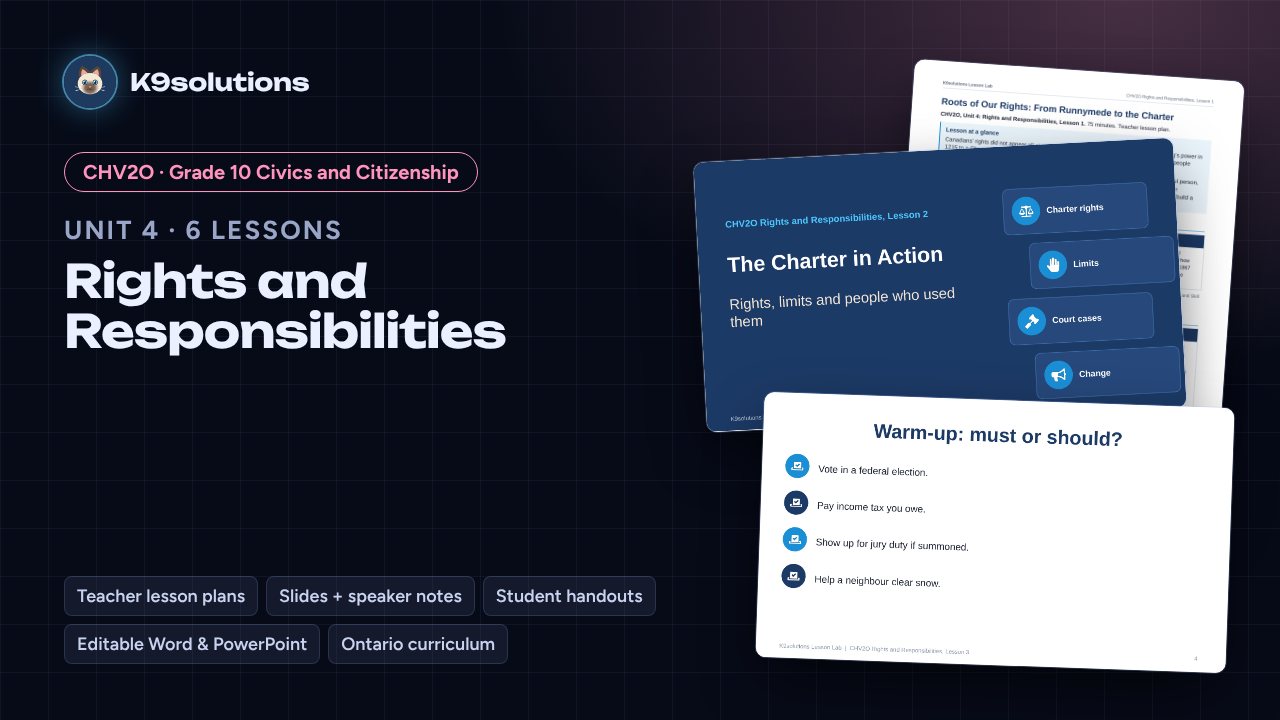
Students trace Canadians' rights from Magna Carta (1215), the Royal Proclamation (1763) and the British North America Act (1867) through the Canadian Bill of Rights (1960) to the Constitution Act, 1982, asking each time who was protected and who was left out. They learn the main groups of Charter rights, the limits in sections 1 and 33 and how people, from disability advocates to francophone parents, used the Charter to create change. They sort legal duties and civic responsibilities, including responsibilities to the land and the treaty relationship, meet the courts, juries, tribunals, human rights commissions, ombudspersons and restorative justice, connect Canada to the UDHR, the Convention on the Rights of the Child and UNDRIP, and judge how effectively the world has responded to human rights violations. The summative, the Rights Case File, asks them to analyse a real Charter or human rights case.
Assessment of learning: Rights Case File: analyse a Charter or human rights case, explaining the rights involved, the institutions that decided it and its impact on the public good.
Lessons
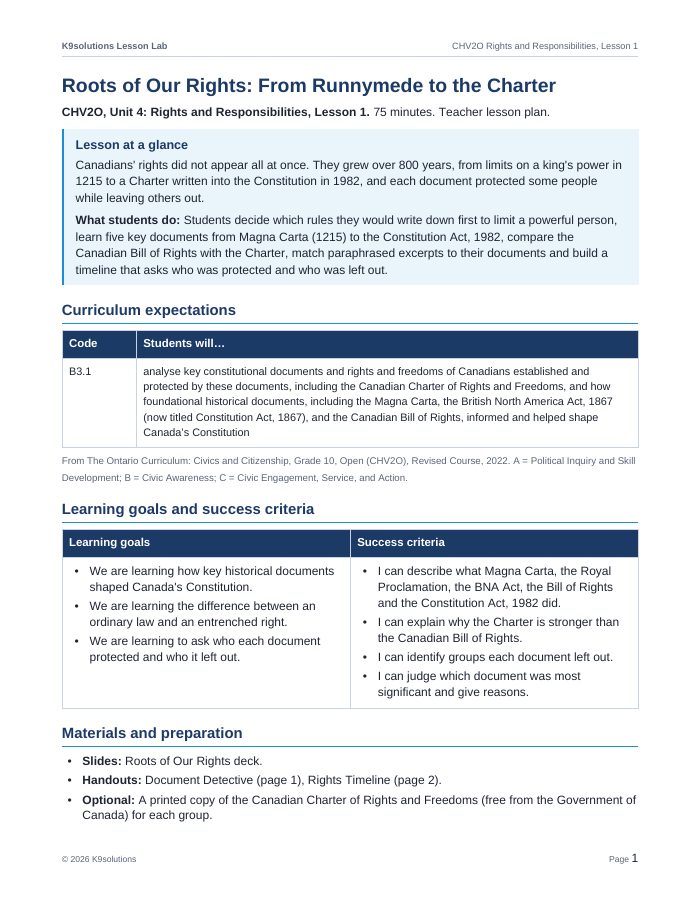
- Roots of Our Rights
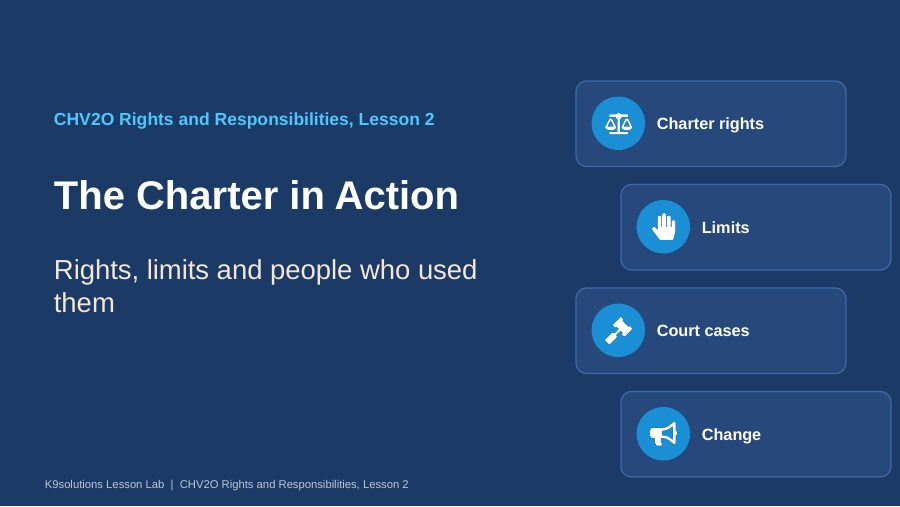
- The Charter in Action
- Responsibilities of Citizenship
- Courts and the Public Good
- Rights in a Global Context
- Responding to Human Rights Violations
What you get
- A teacher lesson plan for every lesson: curriculum expectations, learning goals and success criteria, a timed sequence, differentiation, look-fors and answer guides
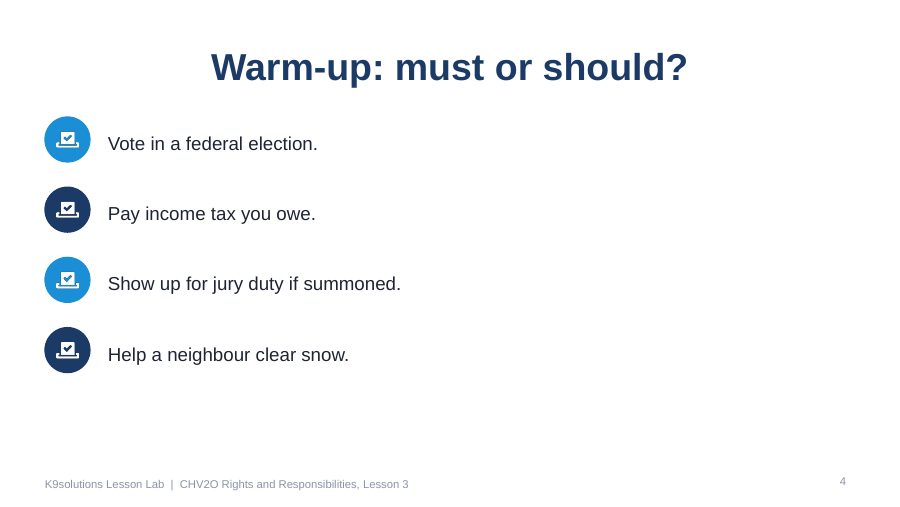
- Detailed slideshows (15 to 18 slides per lesson) with speaker notes on every slide: what to say, what to ask, what to look for and how long to spend, plus warm-ups, worked examples, model answers and answer-key slides
- Student handouts, organizers and exit tickets, with original scenarios and examples
- Editable Word and PowerPoint files, plus PDFs
- A unit overview and the summative task with a rubric and teacher guide
Built for the Ontario curriculum (Civics and Citizenship, Grade 10, Open, CHV2O, revised 2022) and Ontario's 2026 evaluation policy (65% classroom work, 20% final exam, 15% attendance and participation), and easy to adapt for any Canadian civics course.
Need just one lesson? Single lessons from this unit will also be available for CA$3.99 each.
Look inside
Real pages from this download. Click a page to see it full size.
Used this resource? Leave a review
Reviews come to us privately first. With your permission, we may share your first name and comments on this page.