
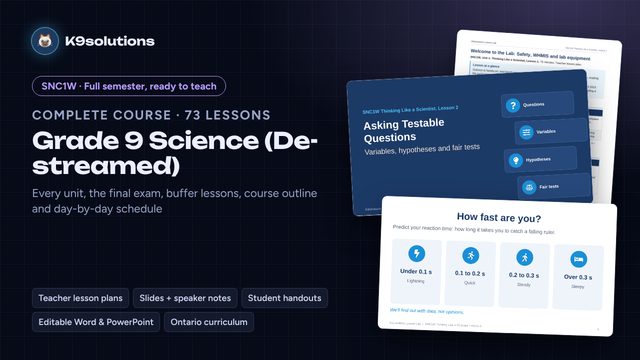
SNC1W Complete Course: Grade 9 Science (De-streamed)
Everything you need to teach the de-streamed Grade 9 Science course for a full semester: six units covering biology, chemistry, physics and space, the culminating task and a final evaluation.
Biology, chemistry, physics and earth science.
8 items
Everything you need to teach the de-streamed Grade 9 Science course for a full semester: six units covering biology, chemistry, physics and space, the culminating task and a final evaluation.
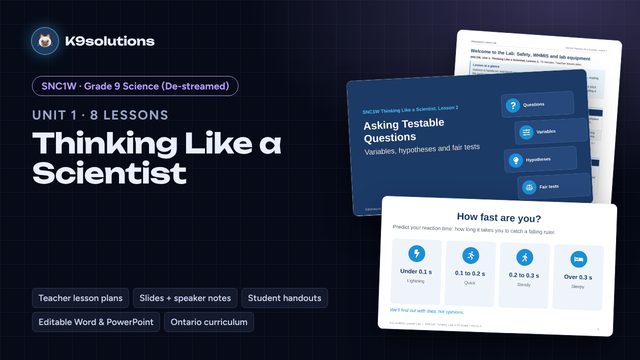
The STEM skills students use all year: lab safety and WHMIS, testable questions and variables, measurement and graphing, a paper-helicopter fair test, research with SIFT, Python coding, an engineering design challenge and the people who do science.
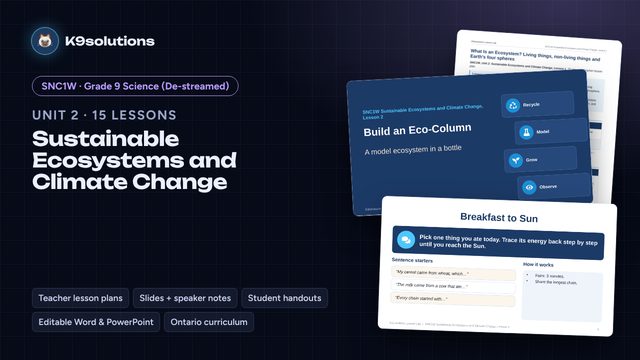
Ecosystems, energy flow, matter cycles, photosynthesis and respiration labs, biodiversity, human impacts and climate change, including impacts on communities across Canada and sustainable practices from First Nations, Métis and Inuit knowledge.
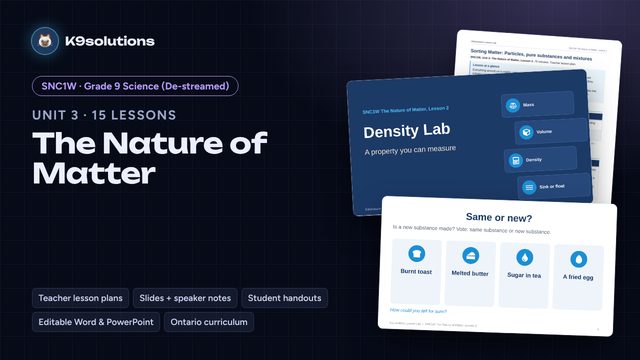
Classifying matter, density, physical and chemical change, atomic models, Bohr-Rutherford diagrams, the periodic table, compounds and formulas, household chemicals and the life cycle of consumer products.
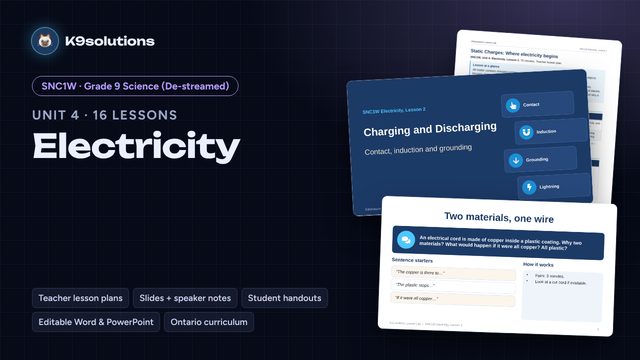
Static and current electricity, conductors, circuits, Ohm's law (by hand and in Python), series and parallel circuits, power, energy cost and efficiency, Ontario's electricity sources and an energy action plan.
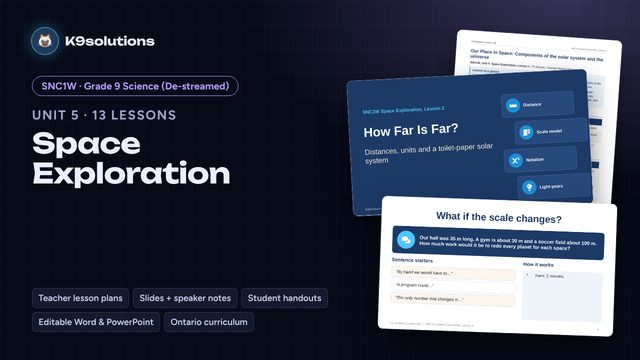
The solar system and universe, astronomical distances and scale, the Sun, seasons, Moon phases and eclipses, the origin of the universe, many ways of knowing the sky, satellites and the impacts of space exploration.
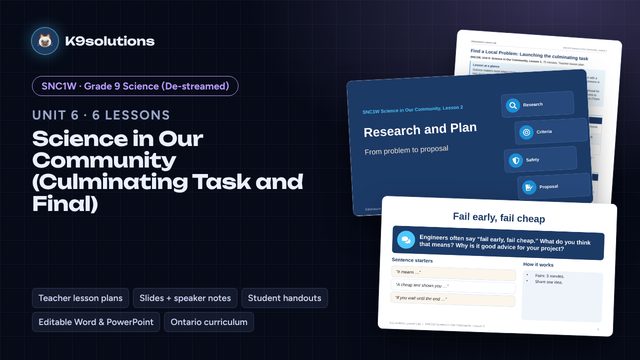
The end of the course: a culminating design project on a real local problem, linked to STEM careers and skilled trades, plus a course review and an original final written exam with an answer key.
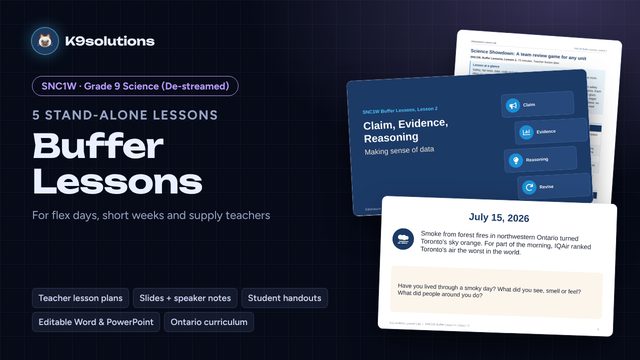
Five stand-alone SNC1W lessons for flex days, short weeks and supply teachers, each tied to specific curriculum expectations.
8 items
Everything you need to teach Grade 10 Academic Science for a full semester: a skills launch, biology, chemistry, climate change and optics units, an independent investigation and a final exam.
A short launch unit for the skills students use all year: lab safety, controlled inquiry and the lab report, significant digits and percent error, reliable sources and APA citations, and Canadian scientists and careers.
Cells under the microscope, the cell cycle and mitosis, cancer, specialized cells and stem cells, plant and animal tissues, organs and systems, a dissection, disease, medical imaging, public health and ethics.
Ions, naming and formulas for ionic and molecular compounds, evidence of chemical change, conservation of mass, balancing equations, the main reaction types, acids, bases and neutralization, and reactions in safety and the environment.
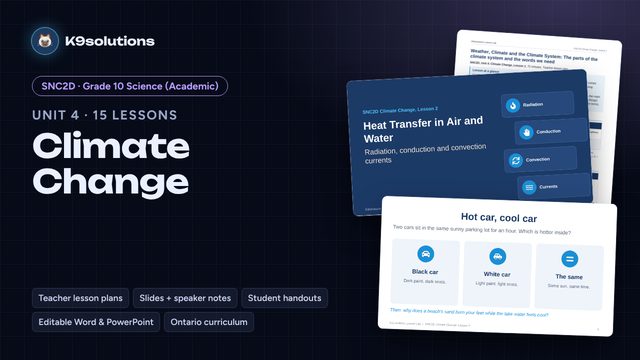
The climate system, heat transfer, albedo, ocean currents, the greenhouse effect, greenhouse gases, ozone and smog, proxy data, natural and human causes, climate regions, global effects, media literacy and climate initiatives.
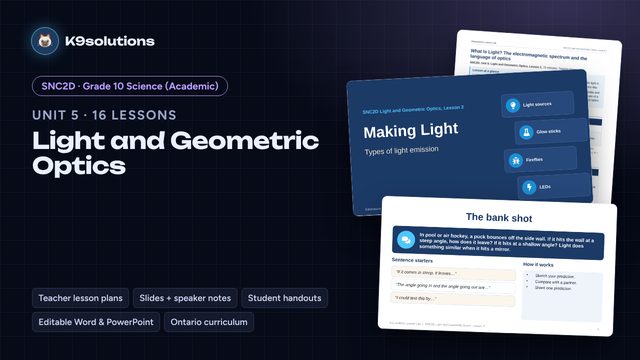
The electromagnetic spectrum, sources of light, reflection, plane and curved mirrors, ray diagrams, the mirror and thin lens equations, refraction and the index of refraction, total internal reflection, lenses, the eye and light technologies.
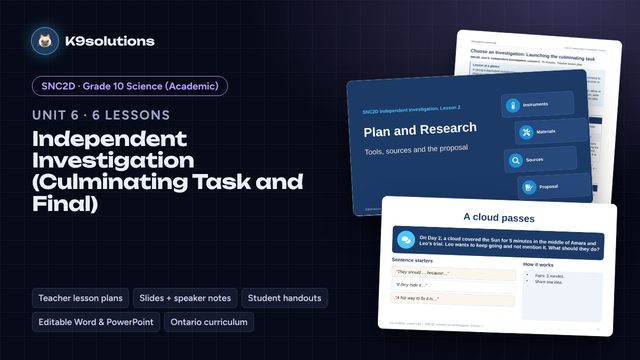
The end of the course: an independent inquiry or research investigation with a proposal, safety plan, analysis and presentation, plus a course review and an original final written exam with an answer key.
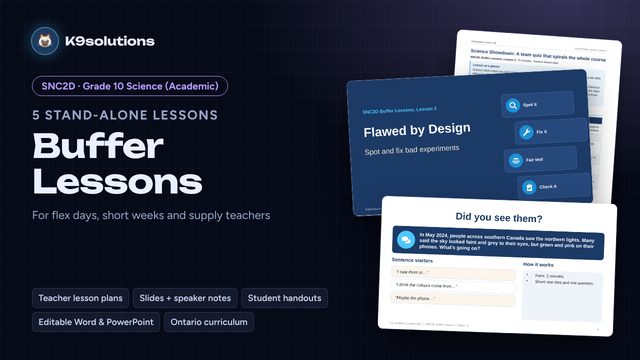
Five stand-alone SNC2D lessons for flex days, short weeks and supply teachers, each tied to specific curriculum expectations.
No lesson plans match that. Try another word.